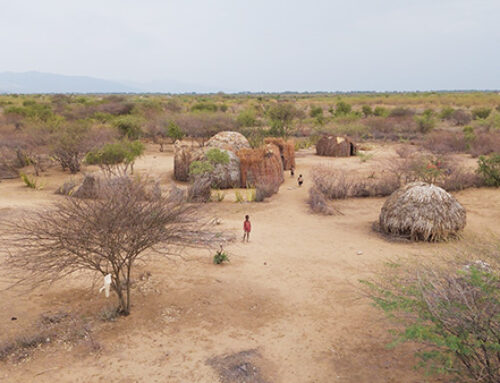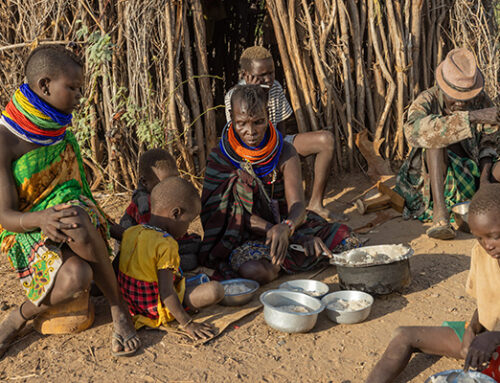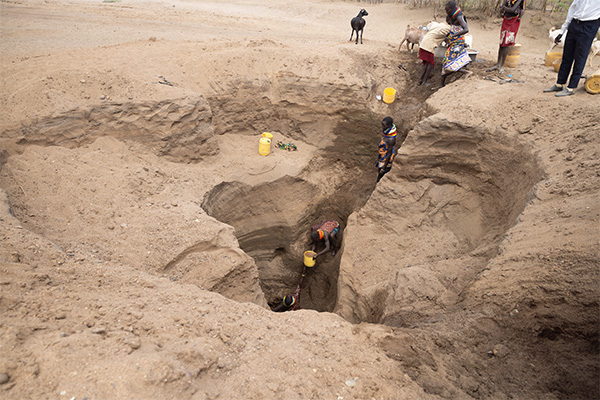
A daily task for women and girls in Turkana is collecting water. Often, the water source is three to five kilometres away. Occasionally, when it rains in Turkana, women can go to the river to collect water. But with the many droughts that have plagued Turkana over the last fifty years, the riverbed is dry. To access water, deep holes must be dug down into the sand. The longer the drought, the deeper the hole must go. Sometimes a bucket chain of five people is needed to bring water from the hole up to the top. The villagers take turns standing at the very bottom. They know that the soft sand can collapse at any time, burying them alive.
The designated water fetcher leaves home around 6:00 a.m., before it gets too hot. The walk to the riverbed can be pleasant in the morning breeze. Families would build their homes closer to the river, but when it does rain hard — and occasionally it does — the land around the riverbed floods. As you get closer to the river, the small forest of shrubby trees grows thicker and the path narrows. If you are not careful, you can get a nasty jab from one of the thorny bushes.
Once you arrive, you take your place at the top of the water hole. Sometimes the queue is quite long. As you get close, you may be recruited to take a turn in the “bucket brigade.” It is not a job for the weak of heart or body. Spend five minutes passing buckets of water up the chain, and you will know what I mean.
Finally, your jerry can is full, and you can start the long walk home. This time, the journey is harder. The sun is high, the temperature has risen to 38 degrees Celsius, and the load pressing down on your head is heavy. You need to stop and rest several times, but every time you set the can down, you will have to struggle to lift it back up. By the time you reach home, it is about noon.
But how far does a jerry can of water go for a family of six? Should you make another trip, or resign yourself to another day of rationing?
You rest and drink a cup of tea brewed from the water you just fetched — not real tea from the fields of Kenya; that would cost money you do not have. Your tea leaves come from the trees that grow naturally near your home. Tomorrow is another day, another trip to the river.